
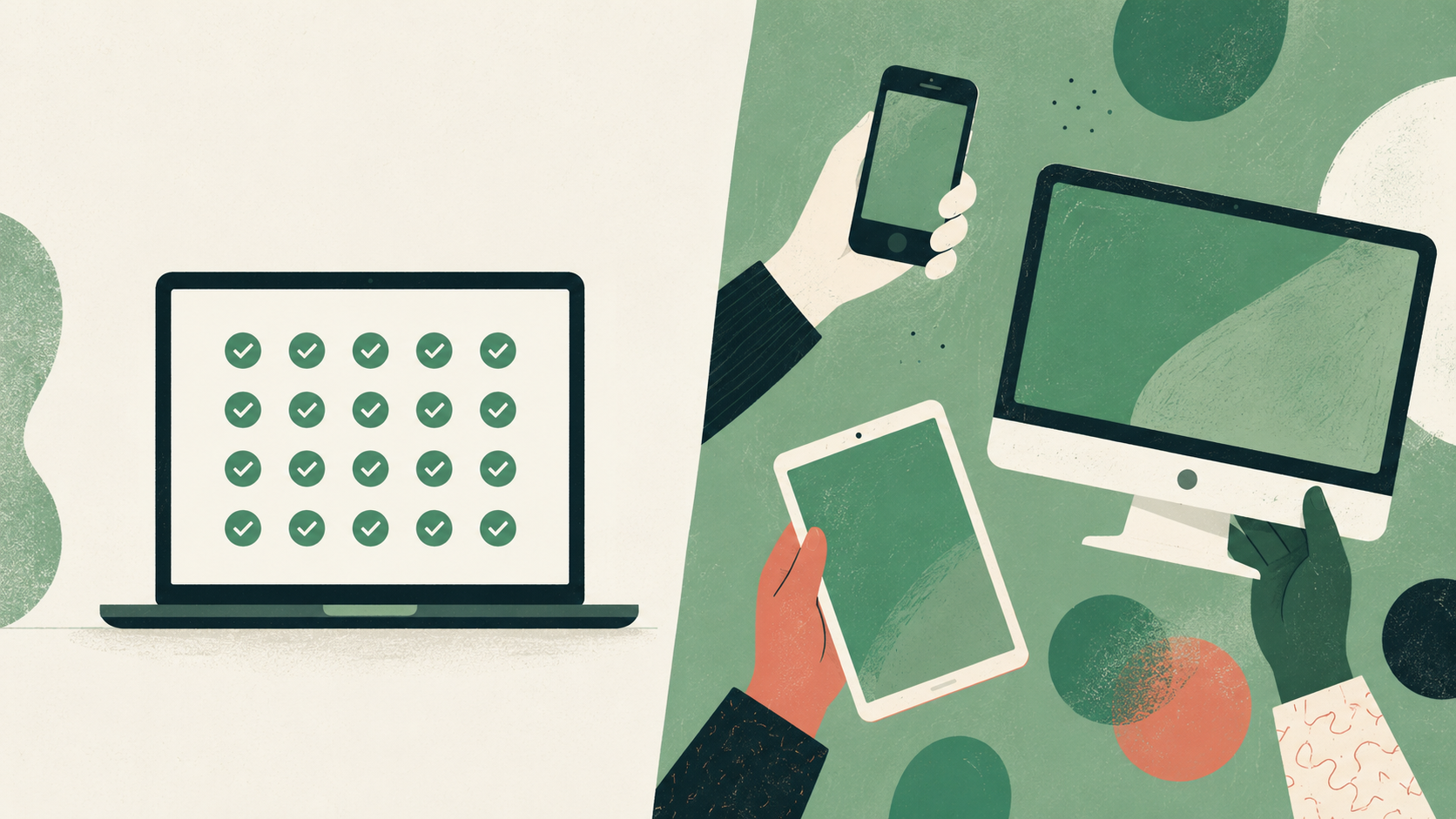
Your CI pipeline is green. Every unit test passes. Coverage is at 84%. And your last three churned accounts all cancelled inside the first week without filing a single bug report.
That gap is not a testing failure. It's a testing blind spot. Automated tests confirm your software does what you told it to do. They cannot tell you whether a stranger on a three-year-old Android phone, on hotel Wi-Fi, with a password manager fighting your signup form, can actually get to value.
Finding that out requires people. Not a lot of them, not for very long — but real ones, on their own devices, who have never seen your product before.
This guide covers when you need real-user testing, what to hand to testers versus what to keep automated, how to write a test task that returns something usable, and what it costs.
What your test suite structurally cannot see
Automated testing is excellent at regression. It is blind to almost everything else:
First-run confusion. You cannot write an assertion for "the user didn't understand what to click next." Your team has seen the onboarding four hundred times. A tester seeing it for the first time is measuring something your CI has no access to.
Device and environment reality. Your staging environment is a clean Chrome instance on a fast connection. Your users have ad blockers, translation extensions, custom DPI scaling, 4-year-old iPhones, corporate proxies, and a browser with 40 tabs
open. Cross-browser tools simulate some of this. Actual devices in actual hands cover the rest.
Third-party flows you don't control. OAuth handoffs, Stripe checkout, SMS verification, email deliverability, calendar invites. These break in ways your mocks never reproduce — and they break silently, at the exact moment a user is deciding whether to pay you.
Copy that reads as a lie. A button labeled "Free trial" that immediately asks for a card is technically working. It's also the reason someone bounced. No test suite flags tone, clarity, or a broken expectation.
Localization and RTL. German compound nouns overflowing your nav. Arabic breaking your layout. A date format that means something different in Vilnius than in Chicago.
Accessibility in practice. Automated scanners catch missing alt text and contrast ratios. They don't catch a keyboard trap in your modal or a screen-reader flow that's technically labeled and practically unusable.
Six signs your SaaS needs human testing right now
If two or more of these are true, you're overdue:
- You're shipping to a new platform or breakpoint. New mobile web layout, a first Android build, a redesigned dashboard.
- Your signup-to-activation drop-off has no explanation in the analytics. Users leave at a step you're certain works.
- You're changing pricing, billing, or checkout. These are the flows where a bug costs revenue directly, not eventually.
- You're entering a new market or adding languages. Nothing exposes a translation problem like a native speaker.
- Your entire team is a power user of your own product. Everyone knows the workarounds. Nobody remembers the confusion.
- Support tickets describe problems you cannot reproduce. Usually a device, browser extension, or network condition nobody on the team has.
What to give humans, and what to keep automated
Crowdsourced testing is not a replacement for your test suite. It covers a different axis. Split the work like this:
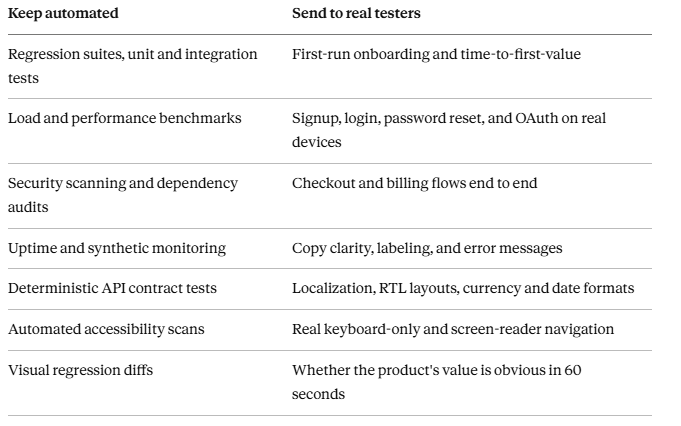
The rule of thumb: automate anything with a single correct answer; use people for anything where the answer is a judgment.
How crowdsourced testing works on a microtask platform
Traditional QA outsourcing means a contract, a scoping call, a minimum engagement, and a two-week turnaround. A microtask platform compresses that into an afternoon. On TaskerData, a software testing campaign runs in four steps:
1. You post the campaign. Write the instructions, attach the URL or build link, choose what proof you need — typed responses, screenshots, or a recorded video — and set a fixed payout per tester. Software testing tasks typically pay between $0.50 and $5.00 depending on how much work you're asking for. There are no minimums, so a 15-tester campaign is as valid as a 300-tester one.
2. Workers pick it up. Testers browse open campaigns, see the exact payout before they start, and work from their own devices anywhere in the world. That geographic and hardware spread is the point — it's the variety you can't buy from a single contractor.
3. They submit proof. Each tester returns the evidence you asked for. For SaaS testing, a screen recording is usually worth more than a written report: you see the hesitation, the misclick, the moment they scroll past your CTA.
4. You review and pay. Approve, reject, or request revisions on every submission. You only pay for work you approve. Approved testers are paid automatically from the campaign balance.
If you need testers with specific characteristics — a particular OS, a language, prior experience with a category of tool — you can attach an optional qualification test to screen applicants before they take the task.
How to write a test task that returns something usable
This is where most first campaigns go wrong. "Test my app and tell me what you think" produces fifty submissions that all say "looks good, works fine." Vague instructions get vague proof.
Give them a goal, not a checklist. Instead of "click Sign Up, then enter email, then click Continue," write: "You're a freelance designer who needs to send a client an invoice. Sign up and get an invoice sent. Record your screen the whole time." Now you're testing whether the path is discoverable, not whether the buttons exist.
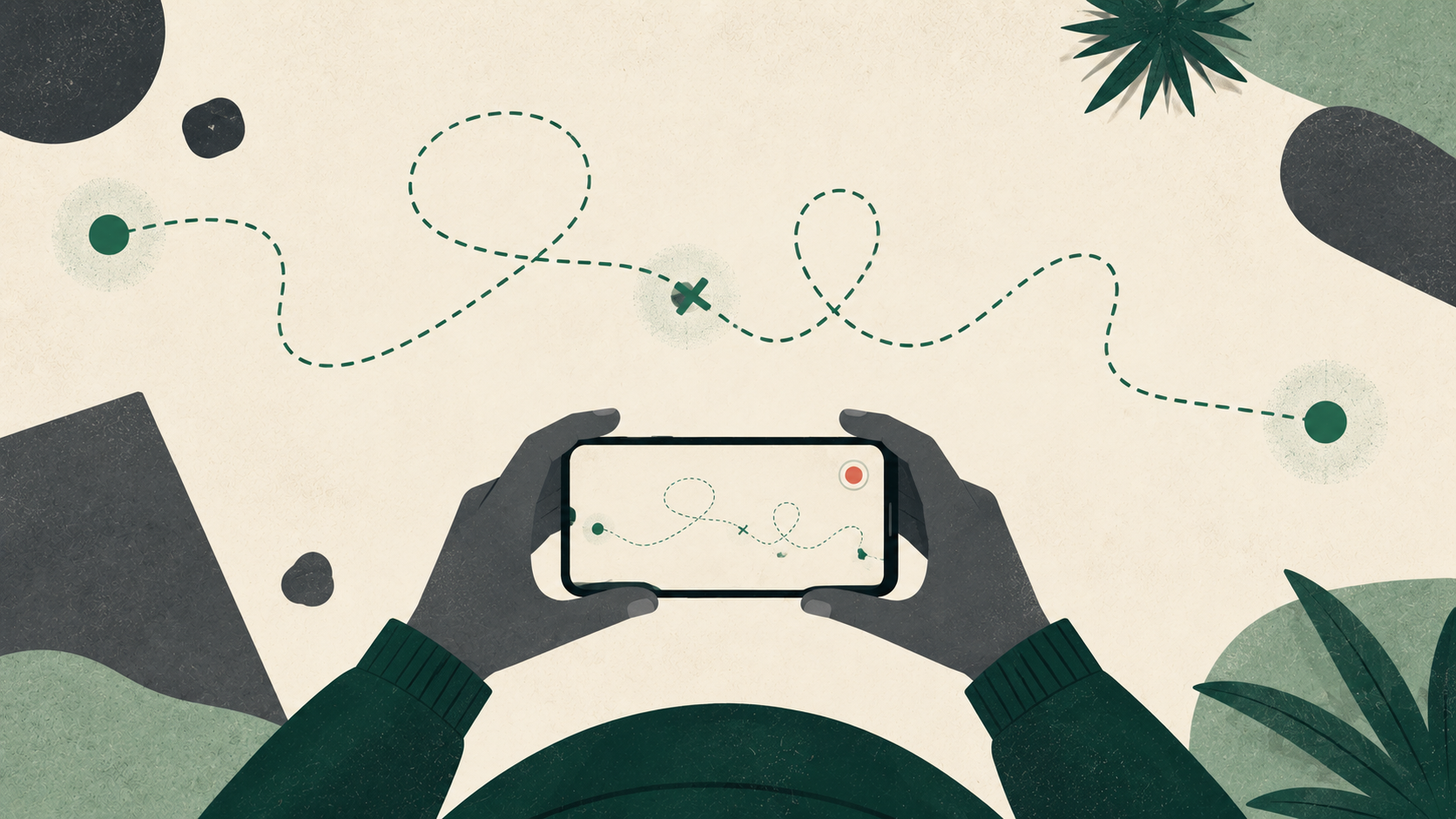
Ask for the moment of confusion explicitly. Add a required field: "At what point were you unsure what to do next? Quote the exact text on screen." This single question surfaces more usable insight than any other.
Require proof that can't be faked. A screenshot showing the final state, a screen recording, or a value from a unique confirmation screen. Ask for something only someone who genuinely completed the flow would have.
Cap the time and say so. "This should take about 8 minutes." Testers self-select accurately when they know the effort, and your payout looks fair against it.
Specify the environment when it matters. If you're chasing a Safari bug, say Safari, and require a screenshot of the browser UI as proof.
Ask one open question at the end. "If you had to guess, what does this product do and who is it for?" If the answers don't match your positioning, you have a marketing problem, not a bug.
Price honestly. A 10-minute task with a screen recording is not a $0.20 job. Underpaying doesn't save money; it filters for the testers who rush, and you end up rejecting submissions and re-running the campaign.
What it actually costs
A worked example. You want 40 people to complete an onboarding walkthrough with a screen recording, at $2.00 per approved task:
- 40 approved submissions × $2.00 = $80.00 to testers
- Platform fee, 10% = $8.00
- Campaign fee = $2.00
- Total: $90.00
If you reject six submissions as low quality, you pay for 34 - the rejected work costs you nothing.
For comparison, a freelance QA contractor at $45/hour bills roughly $90 for two hours, and gives you one person, one device, one perspective, one set of assumptions. The trade is depth versus spread. Crowdsourced testing wins decisively on spread, which is exactly what onboarding, device coverage, and localization problems require.
Worth checking against alternatives: Amazon Mechanical Turk takes 20% on rewards, plus another 20% on tasks with 10 or more assignments — which is most real testing campaigns. Prolific charges 42.8% for corporate customers. TaskerData is a flat 10% plus the $2 campaign fee. (Full comparisons: MTurk · Prolific · Microworkers)
When crowdsourced testing is the wrong tool
Being straight about this saves you a wasted campaign:
- Anything requiring access to sensitive production data. Don't hand strangers real customer records. Use a seeded staging environment.
- Deep domain expertise. If validating your output requires a radiologist or a tax accountant, hire one.
- Long-horizon workflows. A 30-day retention behaviour isn't a microtask.
- Formal compliance audits. SOC 2 and HIPAA attestation need certified auditors, not crowd testers.
- Security penetration testing. That's a specialist discipline with its own rules of engagement.
For everything upstream of those — onboarding, checkout, cross-device, copy, localization, first impressions — crowd testing is faster and cheaper than any alternative.
Frequently asked questions
How many testers do I need? For usability and onboarding issues, 15–20 testers surface the large majority of problems, with sharply diminishing returns after that. For device and browser coverage, scale up — you're buying variety, not consensus, so 50–100 makes sense.
How do I know testers actually did the work? Require proof that only genuine completion produces: a screen recording, a screenshot of a unique confirmation state, or a value that only appears at the end of the flow. Then review each submission and reject anything that doesn't hold up. You don't pay for rejected work.
Can I test a product that isn't public yet? Yes. Point the campaign at a staging URL or a TestFlight build. Keep test data seeded and synthetic, and treat anything you share as public — this is an open marketplace, not a signed-NDA arrangement.
How fast do results come back? Small campaigns typically start returning submissions within hours of publishing. The bottleneck is usually your review time, not tester availability.
Is this the same as beta testing? Related but different. Beta testers use your product over weeks and report as they go. Crowd testers execute a specific scenario once, on demand, and hand you proof. Crowd testing is better for answering a defined question quickly; beta programs are better for long-run engagement.
What proof format should I ask for? Screen recordings for anything involving navigation or confusion. Screenshots for verifying a specific end state. Typed responses for judgments about copy, clarity, and positioning. Most good SaaS test campaigns combine a recording with two or three short written questions.
Start with one flow
Don't try to test the whole product. Pick the single flow where you're losing the most money — usually signup-to-activation or checkout — and put 20 real people through it with a screen recording and one open-ended question.
You'll learn more in an afternoon than in a month of reading funnel charts.
Post your first testing campaign →
Free to join. No subscription. You only pay for work you approve.