

Need 1,000 people to complete an online task? Whether you are collecting data, running a survey, testing a website, gathering images, validating information, or building an AI dataset, finding enough people can be difficult if you try to manage everything manually.
The good news is that businesses no longer need to recruit every participant individually. Crowdsourcing and microtask platforms make it possible to distribute the same type of task to hundreds or thousands of workers.
In this guide, we'll explain how businesses can organize large-scale online tasks, how much they can cost, how to maintain quality, and how to choose the right approach.
Why Would You Need 1,000 People?
Many business projects require a large number of individual actions rather than one large complicated project.
For example, you might need:
- 1,000 people to complete a survey
- 1,000 product photos from different locations
- 1,000 website tests
- 1,000 pieces of data verified
- 1,000 images categorized
- 1,000 product listings checked
- 1,000 people to watch and evaluate a video
- 1,000 responses for market research
- Thousands of human evaluations for an AI project
Trying to complete all of these tasks internally can take a significant amount of time.
Instead, you can divide the project into smaller assignments and distribute them among many workers.
This is the basic idea behind crowdsourcing.
What Is Crowdsourcing?

Crowdsourcing means distributing work to a large group of people, often through an online platform.
Instead of asking one employee to complete 1,000 tasks, you can give the same task to hundreds or thousands of independent workers.
For example:
A company needs 10,000 product images.
Rather than hiring someone to collect all 10,000 images, the company could create a campaign where each worker collects 10 images.
If 1,000 workers participate, the campaign can potentially generate 10,000 images.
The same concept works for surveys, data validation, research, testing, and many other types of work.
5 Ways to Get 1,000 People to Complete an Online Task
There are several ways to organize a large-scale task.
1. Hire Freelancers Individually
You can hire freelancers through freelance marketplaces and assign them the work directly.
This works well when the task requires specialized expertise.
However, managing hundreds or thousands of freelancers individually can quickly become complicated.
You may need to:
- Find workers
- Communicate instructions
- Track progress
- Review submissions
- Process payments
- Resolve disputes
For a project involving 1,000 people, this approach can create a substantial amount of administrative work.
2. Work With an Outsourcing Agency
Another option is to hire an agency to manage the project.
The agency can recruit workers, manage the workflow, and deliver the completed data.
This can be convenient, but it may also increase the overall cost because you are paying for the agency's management and infrastructure.
Agencies can make sense for complex projects, but smaller tasks may not require this level of management.
3. Build Your Own Worker Network
You can create your own community of participants through social media, email lists, online communities, or an existing customer base.
This gives you more control over the relationship with participants.
The disadvantage is that building a network of 1,000 reliable participants takes time.
You also need to manage:
- Recruitment
- Communication
- Task distribution
- Submission collection
- Quality control
- Payments
4. Recruit Through Online Communities
Businesses sometimes recruit participants through forums, social networks, communities, and other online groups.
This can work particularly well for surveys, research studies, and niche audiences.
However, manually recruiting participants can become difficult when you need thousands of completed tasks.
You also have less control over whether participants follow instructions correctly.
5. Use a Crowdsourcing or Microtask Platform
For large numbers of relatively small tasks, a crowdsourcing platform can be one of the most efficient approaches.
Instead of managing individual workers yourself, you create a campaign describing the task.
Workers can then discover the available task, complete it, and submit their work.
The platform can handle much of the distribution and workflow.
What Types of Tasks Can You Crowdsource?

Crowdsourcing isn't limited to surveys.
Businesses can use distributed workers for many different types of online work.
Data Collection
You can ask workers to collect information according to specific instructions.
Examples include:
- Product information
- Business information
- Local data
- Website information
- Images
- Videos
- Prices
- Product availability
Data Validation
You may already have a large dataset but need people to check whether the information is correct.
Workers can verify:
- Names
- Addresses
- Categories
- Product information
- Images
- Website information
- Other structured data
Surveys and Market Research
If you need opinions from a large number of people, crowdsourcing can help distribute surveys and collect responses.
You can also use qualification requirements to target specific types of participants.
Website Testing
Businesses can ask multiple people to perform specific actions on a website and report their experience.
For example:
Visit the website → create an account → find a product → complete checkout → report any problems.
Getting feedback from many different users can reveal issues that internal testing may miss.
Image Collection and Classification
Images can be collected, categorized, or reviewed by distributed workers.
This can be useful for research, computer vision, machine learning, and other data projects.
AI Data Work
Artificial intelligence systems often require large datasets and human evaluation.
Human workers can help with tasks such as:
- Image labeling
- Text classification
- Data validation
- Content evaluation
- AI response evaluation
- Data collection
How Much Does It Cost to Get 1,000 People to Complete a Task?

There isn't one universal price.
The total cost depends on the complexity of the task, the amount of time required, the qualifications you need, and the payment offered to workers.
A simple task that takes two minutes will generally cost much less than a task requiring an hour of specialized work.
A simple calculation can help you estimate the budget.
Total worker budget = number of completed tasks × payment per task
For example:
1,000 tasks × $0.10 = $100
Or:
1,000 tasks × $0.50 = $500
This is only the worker compensation. Depending on the platform and project, there may also be platform fees or other costs.
The important thing is to calculate the cost before launching the campaign.
How to Make 1,000 People Actually Complete Your Task
Getting people to see your task is only half the challenge.
You also need to make the task attractive and easy to complete.
Keep Instructions Simple
Workers should understand what they need to do immediately.
Instead of writing a long explanation, break the task into clear steps.
For example:
Step 1: Open the website.
Step 2: Search for the specified product.
Step 3: Record the displayed price.
Step 4: Submit the required information.
Clear instructions reduce mistakes and increase completion rates.
Explain What Workers Need to Submit
Tell workers exactly what constitutes a successful submission.
If you need a screenshot, say so.
If you need a URL, specify it.
If you need a photograph, explain the required format.
The less ambiguity there is, the easier it becomes to review submissions.
Offer a Reasonable Payment
Workers have many tasks to choose from.
If your task takes significantly longer than competing tasks but pays the same amount, workers may skip it.
Before launching a campaign, estimate how long the task takes for an average worker.
Then make sure the reward is appropriate for the amount of effort required.
Avoid Unnecessary Requirements
Every additional requirement reduces the number of people who can participate.
Only require information that you genuinely need.
For example, if a task doesn't require a specific qualification, don't add one unnecessarily.
How to Maintain Quality With 1,000 Workers

Large-scale crowdsourcing creates another challenge: quality control.
When hundreds or thousands of people complete a task, some submissions will inevitably contain mistakes.
There are several ways to reduce this problem.
Use Qualification Questions
Before allowing workers to access a campaign, you can test whether they understand the task.
Workers who don't meet your requirements can be excluded.
Provide Examples
Show workers examples of correct and incorrect submissions.
Visual examples can be particularly useful for image classification and data collection.
Add Validation Rules
Where possible, use automated checks.
For example, you can verify whether:
- Required fields are completed
- URLs have the correct format
- Numbers are within an expected range
- Duplicate submissions exist
- Required files were uploaded
Review Samples
You don't necessarily need to manually inspect every submission immediately.
Sampling can help you identify whether a campaign is producing consistently high-quality results.
If you notice a problem, you can improve the instructions before more workers complete the task.
How to Scale From 100 to 1,000 Workers

You don't always need to launch a huge campaign immediately.
A better approach can be to start small.
For example:
Stage 1: 50 workers
Stage 2: 100 workers
Stage 3: 500 workers
Stage 4: 1,000+ workers
Use the first group to identify problems with your instructions and workflow.
If workers repeatedly misunderstand a particular instruction, fix it before scaling the campaign.
This can save money and significantly improve the quality of the final dataset.
Using TaskerData to Distribute Online Tasks
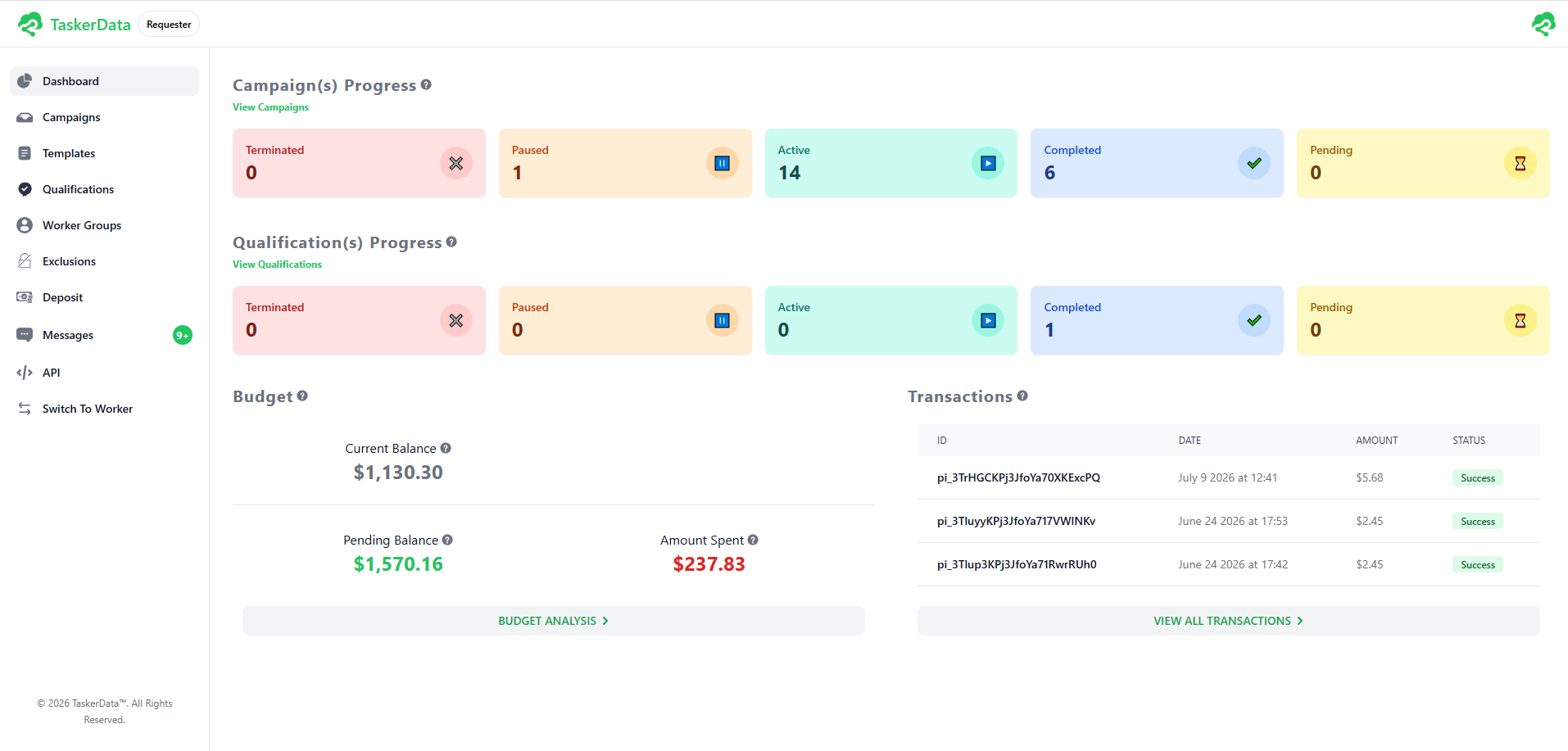
If you need hundreds or thousands of people to complete relatively small online assignments, TaskerData can be used to create and distribute crowdsourced campaigns.
Instead of finding and managing every worker individually, businesses can create a campaign describing the required work.
Depending on the campaign, tasks can involve activities such as data collection, validation, surveys, website visits, testing, image-related work, and other digital assignments.
The basic workflow is straightforward:
Create a campaign → Define the task → Set requirements and payment → Workers complete the task → Review submissions → Receive the completed work
This model allows a business to turn one large project into many smaller assignments that can be distributed across a worker network.
Example: Collecting 10,000 Product Records
Imagine an e-commerce company wants to collect information about 10,000 products.
Each worker could be asked to research 10 products.
The company therefore needs approximately:
10,000 products ÷ 10 products per worker = 1,000 workers
Each assignment could require workers to collect:
- Product name
- Price
- Category
- Product URL
- Product image
- Other specified information
Instead of hiring one person to research all 10,000 products, the company can distribute the work across a large number of participants.
This is where crowdsourcing becomes particularly useful: many people can work on different pieces of the same project simultaneously.
Common Mistakes to Avoid
Making the Task Too Complicated
If workers need 30 minutes to understand a five-minute task, your instructions need improvement.
Paying Too Little
Low compensation can make it difficult to attract enough workers and may reduce completion rates.
Launching Without Testing
Always test your campaign with a small number of workers first.
Not Having Quality Control
A large quantity of data isn't useful if much of it is incorrect.
Asking for Too Much Information
Only collect the information necessary for the project.
Scaling Too Quickly
Fix problems with the workflow before increasing the campaign size.
When Should You Use Crowdsourcing?
Crowdsourcing makes the most sense when your project contains many small, repeatable tasks.
It can be especially useful when:
- You need hundreds or thousands of participants
- Tasks can be completed independently
- You need geographically diverse data
- You need many opinions or observations
- You need large datasets
- You need human verification
- Your internal team doesn't have enough capacity
It may be less suitable when the project requires one person with deep expertise to work on a complex problem from beginning to end.

Final Thoughts
Getting 1,000 people to complete an online task doesn't necessarily mean contacting 1,000 people individually.
By breaking a large project into smaller assignments and distributing those assignments through crowdsourcing, businesses can collect large amounts of data, feedback, research, testing results, and other information more efficiently.
The key is to start with a clearly defined task, provide simple instructions, offer appropriate compensation, establish quality controls, and test the workflow before scaling.
If your business has a project that requires hundreds or thousands of people to complete small online tasks, TaskerData can help you turn that project into a distributed campaign and connect it with online workers.