

Starting and growing a business in 2026 is easier in some ways than ever before. Entrepreneurs have access to powerful AI tools, affordable software, global freelancers, automation platforms, and online communities.
But there is still one major limitation: time.
As a business grows, entrepreneurs often find themselves spending hours on repetitive tasks that don't necessarily require their personal expertise.
Researching products, collecting data, testing websites, gathering customer feedback, verifying information, and completing other small tasks can consume valuable time.
This is where crowdsourcing can become a useful tool for entrepreneurs.
Instead of doing every small task yourself or hiring a full-time employee, you can distribute smaller assignments among a large group of online workers.
What Is Crowdsourcing?

Crowdsourcing is the practice of obtaining work, information, ideas, or services from a large group of people, usually through an online platform.
The basic idea is simple:
Large project → smaller tasks → many participants → completed results
For example, imagine that you need information about 5,000 products.
One person might spend weeks collecting the information.
With crowdsourcing, you could divide the project into smaller assignments and have many workers complete different parts simultaneously.
This can make certain projects significantly easier to organize and scale.
Why Should Entrepreneurs Care About Crowdsourcing?
Entrepreneurs usually have limited resources.
You may have a great business idea but only a small team.
You may also have customers waiting, marketing campaigns to manage, products to develop, and finances to monitor.
Spending hundreds of hours on repetitive data-related tasks can prevent you from focusing on higher-value activities.
Crowdsourcing can help entrepreneurs delegate work that:
- Is repetitive
- Can be completed independently
- Has clear instructions
- Doesn't require extensive specialized knowledge
- Can be divided into smaller assignments
- Needs a large number of people
Instead of asking, “How can I do this myself?”, an entrepreneur can ask:
“Can this task be divided into smaller pieces and completed by many people?”
If the answer is yes, crowdsourcing may be worth considering.
1. Collect Market Research

Market research is essential when launching a new product or entering a new market.
However, collecting information manually can take a considerable amount of time.
Entrepreneurs may want to know:
- What products competitors are selling
- How much products cost
- Which features customers care about
- What customers think about existing products
- Which products are available in different locations
- How competitors present their products
Instead of personally collecting every piece of information, an entrepreneur can create smaller research assignments.
For example, 100 workers could each research 20 products.
That creates information about 2,000 products without requiring one person to research everything.
2. Collect Product Data
E-commerce businesses often work with large amounts of product information.
You may need to collect:
- Product names
- Prices
- Categories
- Product URLs
- Images
- Descriptions
- Availability
- Specifications
If you have thousands of products to research, crowdsourcing can turn the project into many smaller assignments.
This can be particularly useful for entrepreneurs building comparison websites, marketplaces, research databases, or product catalogs.
3. Gather Customer Feedback

Entrepreneurs often need feedback before investing heavily in a product.
You might want to know:
Would people understand this landing page?
Is this product description clear?
Which design would customers prefer?
Can new users complete the signup process?
Instead of asking only friends or existing customers, you can potentially gather feedback from a larger group of people.
A larger sample can reveal patterns that a small group might miss.
4. Test Your Website

Launching a website doesn't mean every visitor will have the same experience.
Different users may notice different problems.
For example, you could ask multiple people to:
- Open your website.
- Find a particular product.
- Create an account.
- Complete a specific action.
- Report anything confusing or broken.
Testing with many users can help identify usability problems before they affect a larger percentage of your customers.
This can be particularly useful for startups launching a new website or application.
5. Collect Images and Other Real-World Data
Some businesses need information that can't simply be generated from an existing database.
For example, you might need photographs of:
- Products
- Storefronts
- Signs
- Locations
- Packaging
- Objects
- Different environments
Instead of sending employees to hundreds of locations, a business can potentially distribute collection assignments to people in different areas.
This creates an opportunity to collect geographically diverse information at scale.
6. Validate Existing Data
You don't always need to create a dataset from scratch.
Sometimes you already have thousands of records but need people to verify them.
For example:
Is this business still operating?
Is this product in the correct category?
Is this address correct?
Does this image match the product?
Is this information outdated?
A simple validation task can be distributed among many workers.
This can be especially useful when maintaining large databases.
7. Support AI and Data Projects

Artificial intelligence has created a growing need for high-quality data.
AI systems can process enormous amounts of information, but businesses may still need humans to collect, review, categorize, or validate data.
Crowdsourced workers can potentially help with tasks such as:
- Image categorization
- Text classification
- Data validation
- Content evaluation
- AI response evaluation
- Data collection
- Human feedback
For entrepreneurs building AI-related products, having access to distributed human workers can make certain data projects easier to scale.
8. Reduce the Need for Manual Work
One of the biggest advantages of crowdsourcing is that entrepreneurs don't necessarily need to personally manage every small assignment.
Imagine you have 10,000 records that need to be checked.
You could assign the entire project to one employee.
Or you could divide the work into smaller tasks and distribute them among many people.
The entrepreneur can then focus on:
- Product development
- Marketing
- Sales
- Customer relationships
- Strategy
- Business development
The goal isn't simply to outsource everything.
It's to remove repetitive work that doesn't need to consume the entrepreneur's time.
9. Scale Small Teams

A startup doesn't need hundreds of employees to access hundreds of people.
That's one of the interesting advantages of crowdsourcing.
A small company might have:
3 employees internally
while also using:
100+ online workers for specific projects.
The internal team remains focused on the core business while distributed workers handle clearly defined assignments.
This can be particularly useful for startups that don't have the resources to hire large teams.
How to Decide If a Task Is Suitable for Crowdsourcing
Not every business task should be crowdsourced.
A good crowdsourcing task usually has several characteristics.
The task can be divided
Large projects should be broken into independent assignments.
The instructions are clear
Workers should know exactly what is expected.
The result can be measured
You should be able to determine whether a submission is correct.
The task doesn't require deep internal knowledge
Highly strategic or confidential work may be better handled internally.
There is enough volume
Crowdsourcing becomes particularly interesting when you need hundreds or thousands of actions.
How to Create a Good Crowdsourcing Task
The quality of your results depends heavily on the quality of your instructions.
A good task should clearly explain:
1. What needs to be done
Don't assume workers know what you mean.
2. How to complete it
Give simple step-by-step instructions.
3. What to submit
Specify exactly what information, files, screenshots, or other evidence are required.
4. What makes a submission acceptable
Give examples whenever possible.
5. How much the task pays
Workers should understand the reward before deciding whether to participate.
Clear instructions can reduce errors and make the campaign easier to manage.
How Much Does Crowdsourcing Cost?
There is no fixed price for crowdsourcing.
The cost depends on the complexity and duration of the task.
A simple assignment that takes one or two minutes might require only a small payment.
A task requiring research, specialized knowledge, or significant effort will generally need higher compensation.
A simple starting calculation is:
Number of tasks × payment per task = worker budget
For example:
5,000 tasks × $0.10 = $500
The final cost can also depend on platform fees, quality-control requirements, and other project expenses.
Before launching a campaign, estimate how long the task will take an average worker and determine whether the economics make sense for your business.
Using TaskerData for Crowdsourced Business Tasks

Entrepreneurs who need a large number of people to complete small online assignments can use a crowdsourcing platform such as TaskerData.
Instead of finding and managing every worker individually, you can create a campaign describing what needs to be completed.
Potential use cases include:
- Data collection
- Data validation
- Surveys
- Website visits
- Testing
- Image-related tasks
- Research
- Video promotion
- Other repeatable online assignments
The basic process is:
Create a campaign → Define the requirements → Set the reward → Workers complete assignments → Review submissions → Receive the results
This approach allows entrepreneurs to turn a large project into many smaller tasks that can be distributed among online workers.
Crowdsourcing vs Hiring an Employee
Crowdsourcing isn't necessarily a replacement for employees.
The two approaches solve different problems.
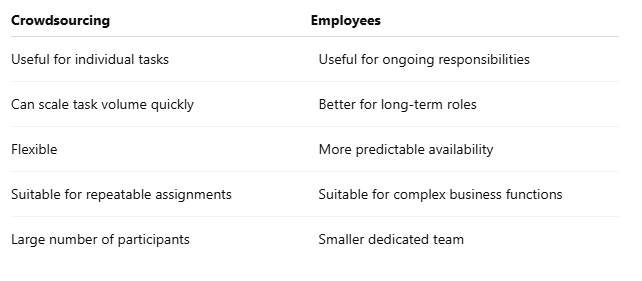
An employee may be the right choice when you need someone to deeply understand your business and work with you every day.
Crowdsourcing can make more sense when you have a large volume of smaller, clearly defined assignments.
Crowdsourcing vs Freelancing
Freelancers are often ideal when you need one person with a specific skill.
For example:
“Build me a website.”
That's generally a freelance project.
But if you need:
“Collect information from 10,000 product pages.”
The work may be easier to divide into many smaller assignments.
That's where crowdsourcing becomes more interesting.
The right choice depends on the nature of the work.
A Practical Example
Imagine an entrepreneur is launching a price-comparison website.
They need information about 20,000 products.
Each product requires:
- Product name
- Price
- Category
- URL
- Image
- Availability
Instead of hiring one person to research all 20,000 products, the entrepreneur could divide the project into assignments of 20 products each.
That creates:
20,000 ÷ 20 = 1,000 assignments
Those assignments can then be distributed among online workers.
The entrepreneur can monitor the campaign, review submissions, and build the final dataset from the completed work.
This is the fundamental advantage of crowdsourcing:
A large project becomes a collection of manageable tasks.
The Future of Entrepreneurship Is More Distributed
Entrepreneurship in 2026 isn't only about having a great idea.
It's also about knowing how to use technology, automation, AI, freelancers, software, and distributed workers to execute that idea efficiently.
A small startup can now access resources that previously required a much larger organization.
AI can help with analysis and automation.
Cloud software can handle infrastructure.
Freelancers can provide specialized expertise.
And crowdsourcing can provide access to large numbers of people for specific tasks.
The entrepreneur's job is increasingly becoming one of coordination and leverage.

Final Thoughts
Crowdsourcing can be a powerful tool for entrepreneurs when used for the right type of work.
If a project involves hundreds or thousands of small, repeatable assignments, distributing those tasks among a large group of online workers can save time and help a small team accomplish more.
The key is to start with a clearly defined task, test it with a small group, establish quality controls, and scale only after the process works.
Whether you're conducting market research, collecting product data, testing a website, validating information, or building an AI dataset, crowdsourcing can give entrepreneurs another way to expand their capabilities without immediately expanding their internal team.
If you have a project that requires many people to complete online tasks, TaskerData can help you turn that project into a structured campaign and distribute the work to online workers.