
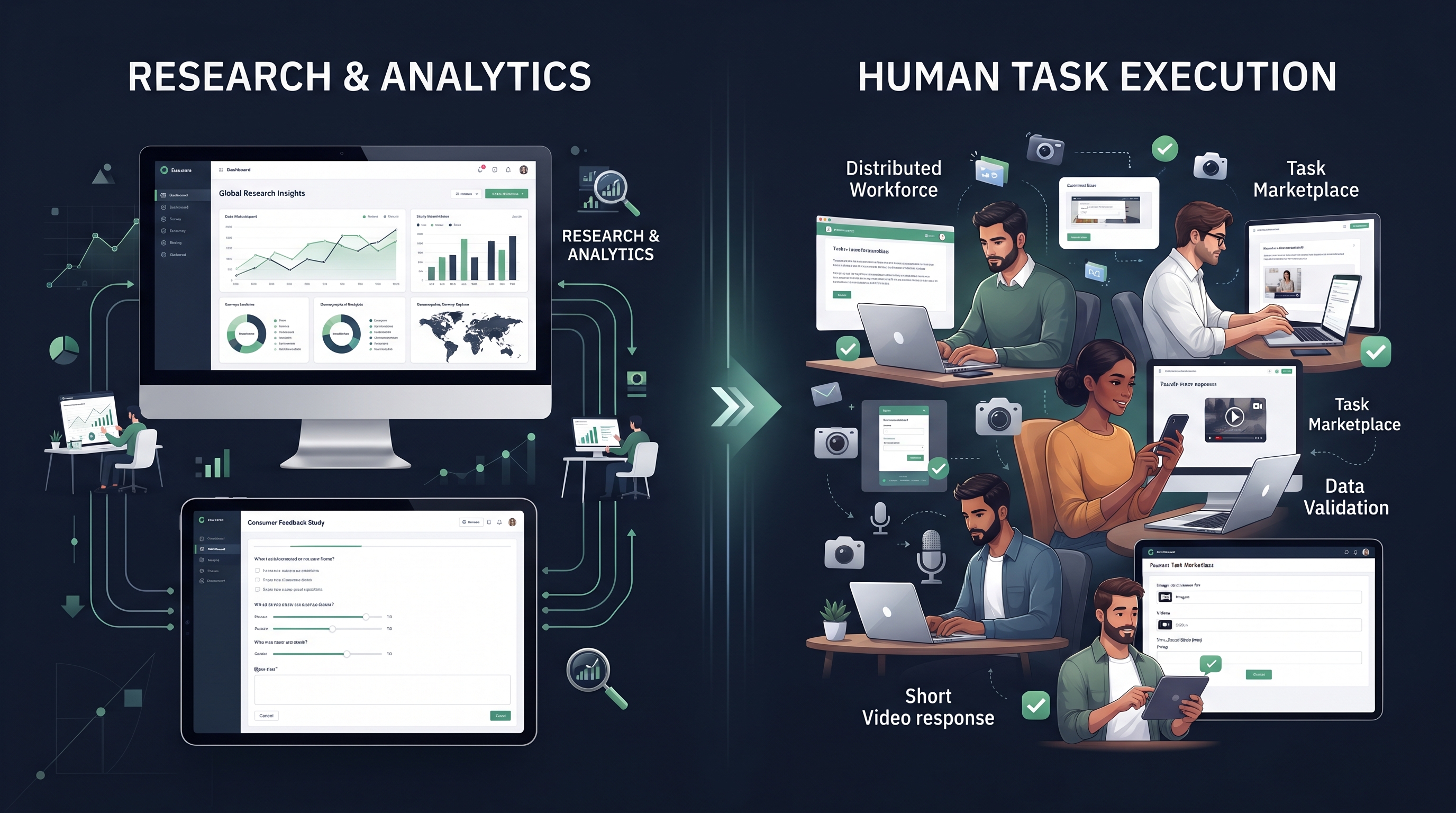
Businesses increasingly need real people to provide feedback, test products, collect information, and complete tasks at scale. Two platforms that can be relevant to these needs are TaskerData and Qualtrics—but they approach the problem from very different directions.
Qualtrics is an established research and experience-management platform built around surveys, research methodologies, analytics, dashboards, and customer or employee experience programs. TaskerData is a microtask marketplace designed to connect businesses with a workforce that can complete tasks and submit evidence such as text, screenshots, images, videos, and structured data.
So which one should you use?
The answer depends on what you actually need people to do.
TaskerData vs Qualtrics at a Glance
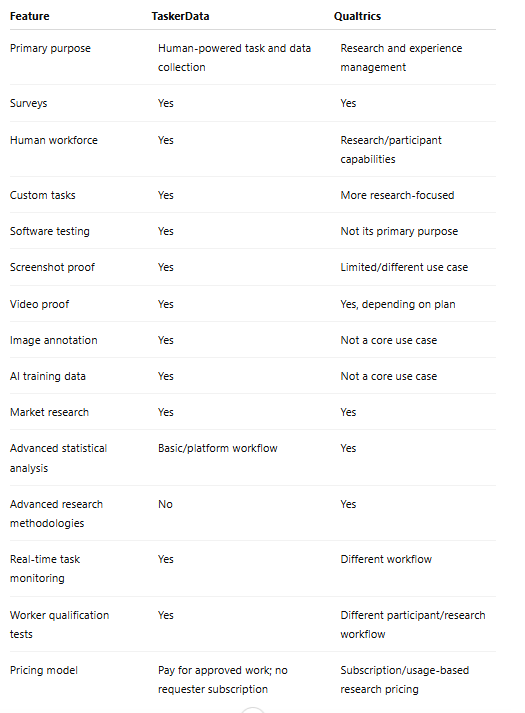
The biggest difference is simple:
Qualtrics is primarily research software. TaskerData is primarily a human task execution platform.
What Is Qualtrics?
Qualtrics is a large experience-management and research platform used for customer experience, employee experience, strategy, and research.
Its research products provide tools for building surveys, collecting responses, running research methodologies, analyzing data, and creating dashboards. Qualtrics currently offers Strategic Research with features such as advanced question types,
video and audio feedback, concept testing, conjoint, MaxDiff, statistical analysis, and dashboards.
This makes Qualtrics particularly useful when an organization needs sophisticated research infrastructure.
For example, a company might use Qualtrics to:
- Run a customer satisfaction study
- Conduct product research
- Measure brand perception
- Run employee surveys
- Perform concept testing
- Analyze survey results
- Build research dashboards
- Conduct large-scale quantitative research
Qualtrics is therefore a strong choice when the research methodology and analysis itself are the primary requirements.
What Is TaskerData?
TaskerData takes a different approach.
Instead of primarily giving businesses research software, TaskerData provides a marketplace where businesses can create campaigns and have workers complete tasks.
A requester can define instructions, specify the required proof, set a payout, publish the campaign, monitor submissions, and approve or reject completed work. TaskerData supports proof such as text, screenshots, images, video, and form data.
Tasks can include:
- Website and app testing
- Data collection
- Surveys and market research
- Image annotation
- AI training data
- Website testing
- Product feedback
- Content-related tasks
- Data verification
This creates an important distinction.
Qualtrics helps you build and analyze research.
TaskerData helps you get people to perform work and return evidence.
The Biggest Difference: Responses vs. Actions

This is probably the most important distinction between the platforms.
Imagine you want to understand how people react to a new website.
With a traditional research platform, you could ask participants questions such as:
Which version of the landing page do you prefer?
Or:
How easy was the website to navigate?
That's a research-oriented workflow.
With TaskerData, you could instead create a task such as:
Visit this website on your phone. Find the pricing page. Complete the signup process up to the payment screen. Record a short video of your experience and explain anything that was confusing.
Now you're not simply collecting a response.
You're asking people to perform an action and provide evidence.
That distinction makes TaskerData potentially useful for UX testing, website testing, data verification, product testing, and other workflows where the participant needs to actually do something.
TaskerData vs Qualtrics for Surveys

If your only requirement is creating a sophisticated survey, Qualtrics has a major advantage.
Qualtrics provides extensive survey functionality, including branching logic, multiple question types, templates, quotas, advanced analysis, and research-specific capabilities. Its Strategic Research offering includes 23 question types and advanced statistical analysis tools.
TaskerData approaches surveys differently.
Rather than focusing primarily on being a sophisticated survey-design environment, TaskerData focuses on getting workers to complete the requested task and returning the required information or proof.
For example
:
Qualtrics:
Create a 30-question customer research survey.
TaskerData:
Get 500 people to answer these questions and submit the required information.
If your challenge is survey methodology and analytics, Qualtrics is likely the better fit.
If your challenge is getting people to complete a task and provide evidence, TaskerData may be more appropriate.
TaskerData vs Qualtrics for Software Testing

This is an area where TaskerData has a fundamentally different use case.
Suppose you're launching a mobile application.
You might want 100 people to:
- Install the application.
- Create an account.
- Test a specific feature.
- Try to complete a particular workflow.
- Record their experience.
- Submit screenshots or a video.
- Report anything that doesn't work.
TaskerData is designed around this type of workflow.
Requesters can create app and website testing campaigns and require video and text proof from workers.
This is different from simply asking someone what they think about an application.
You can ask them to use it.
TaskerData vs Qualtrics for Data Collection
Data collection is another area where the platforms can overlap but still serve different purposes.
A company might need hundreds of people to collect or verify information.
For example:
Visit 10 local business websites and record their opening hours, address, and phone number.
Or:
Look at this product image and identify the product category.
Or:
Test whether this website works correctly on your device and submit a screenshot.
These are essentially human-powered data tasks.
TaskerData is built around distributing this type of work across workers and collecting the resulting submissions.
Qualtrics can certainly collect structured information through surveys and research projects, but that isn't the same as operating a general-purpose microtask workforce.
TaskerData vs Qualtrics for AI Training Data
The difference becomes even clearer with AI data.
AI companies frequently need people to label or classify data.
Examples include:
- Image classification
- Bounding-box annotation
- Text classification
- Sentiment labeling
- Data verification
- Content categorization
TaskerData supports image annotation and structured data collection as campaign types.
For example, a requester could create a campaign asking workers to label objects in images.
This is fundamentally different from conducting a customer research survey.
Therefore, for human-in-the-loop data collection, TaskerData may be worth considering alongside traditional research platforms.
Pricing: TaskerData vs Qualtrics
Pricing is another major difference.
Qualtrics currently lists its self-service Strategic Research offering at $420 per month, billed annually at $5,040, for 1,000 responses shared across users. Its enterprise Strategic Research offering uses custom pricing.
TaskerData uses a different model.
Requesters can create an account without a subscription and fund campaigns based on the work they want completed. TaskerData states that requesters pay for approved work rather than paying a recurring subscription fee.
That means the platforms can make sense for very different budgets.
For a research department running sophisticated studies every month, paying for specialized research software can make sense.
For a startup that needs 100 people to test a website or collect a specific set of data, a task-based model can be more attractive.
When Should You Choose Qualtrics?
Qualtrics is likely the better choice when you need:
- Advanced survey creation
- Sophisticated research methodologies
- Statistical analysis
- Research dashboards
- Customer experience management
- Employee experience programs
- Complex survey logic
- Large research programs
- Established enterprise research workflows
Qualtrics has been built specifically around these requirements.
If your organization has a dedicated research team and needs advanced research capabilities, Qualtrics is difficult to compare directly with a microtask marketplace.
When Should You Choose TaskerData?
TaskerData may be a better fit when the objective is to get people to do something, rather than simply answer a questionnaire.
Examples include:
- Test my website
- Test my mobile app
- Collect information from websites
- Verify business data
- Annotate images
- Collect AI training data
- Gather product feedback
- Complete market research tasks
- Record a product walkthrough
- Submit screenshots
- Collect real-world observations
TaskerData allows requesters to specify the required proof and review submissions before approving payment.
Can TaskerData Replace Qualtrics?
Not completely—and that isn't necessarily the goal.
Qualtrics and TaskerData solve different parts of the data-collection problem.
Think of it this way:
Qualtrics = research software
TaskerData = human workforce + task execution
If you need advanced statistical research, Qualtrics is likely the stronger tool.
If you need 500 people to perform a specific action and return screenshots, videos, or structured information, TaskerData can be a better match.
In some cases, businesses could even use both.
For example, a company could use research software to design its study and use a human workforce to perform specific real-world tasks or testing workflows.
TaskerData as a Qualtrics Alternative for Specific Use Cases
Searching for a “Qualtrics alternative” doesn't necessarily mean looking for a platform with every feature Qualtrics has.
Sometimes businesses are looking for a cheaper or simpler way to solve one particular problem.
For example:
Need 1,000 survey responses?
Qualtrics may be appropriate if you need sophisticated research functionality.
Need 100 people to test your website?
TaskerData may be a better fit.
Need people to record videos while using your application?
TaskerData is designed for campaigns that collect video and text proof.
Need thousands of images labeled?
TaskerData can distribute image annotation work to multiple workers.
Need advanced statistical analysis?
Qualtrics has the advantage.
Need people to perform real-world tasks?
TaskerData has the more direct approach.
Which One Is Better?
There isn't a universal winner.
The better platform depends on what you're trying to accomplish.
Choose Qualtrics when your primary requirement is sophisticated research and analysis.
Choose TaskerData when your primary requirement is getting real people to complete tasks and return verifiable results.
The distinction can be summarized in one question:
Do you need people to answer questions, or do you need people to actually perform work?
For research-heavy projects, Qualtrics is a powerful option.
For human-powered execution, testing, data collection, annotation, and task-based workflows, TaskerData offers a different approach.
And for businesses that don't need an entire enterprise research platform, a task-based marketplace can provide a simpler way to get specific real-world work completed.
Final Verdict
TaskerData and Qualtrics shouldn't be viewed as identical competitors.
They overlap around areas such as surveys, market research, and data collection, but their core models are different.
Qualtrics focuses on research, experience management, sophisticated surveys, and analytics.
TaskerData focuses on connecting businesses with workers who can complete defined tasks and provide proof of their work.
If your problem is:
“I need to design and analyze a sophisticated research study.”
Qualtrics is likely the better choice.
If your problem is:
“I need hundreds of real people to perform this task and send me the results.”
TaskerData may be the better solution.
That's where the two platforms become less of a direct comparison and more of a choice between two fundamentally different approaches to collecting information from people.